Xi Jinping’s Empire of Tedium
坦蕩怡天壽 ・ 其叁
This is Part III of My Father Bao Tong, a biographical essay by Bao Pu written to commemorate the life of his father, Bao Tong.
***
Bao Tong (鮑彤, 1932-2022), former Director of the Office of Political Reform of the Central Committee of the Chinese Communist Party (hereafter, CCP) and the highest-ranked party member of the CCP to be imprisoned after the June Fourth Massacre of 1989, died on 9 November 2022, at the age of ninety.
This biographical essay by his son Bao Pu 鮑樸, a publisher and veteran human rights advocate, was completed on 14 November 2022, and was published in Yibao 議報 on 17 November 2022; this translation is of a revised version of the essay.
A serviceable translation of Bao’s text by Sonia Song was published in the English-language version of Yibao on 23 December 2022. This second translation is perhaps justified by the extent to which the occasional annotations — all of which are those of the translator — might assist readers to understand both the particular trajectory as well as the wider context of Bao Tong’s brave and remarkable life.
I thank both Bao Pu for his gracious permission to translate this finely crafted essay into English, and Geremie Barmé for bringing it to my attention and encouraging me to attempt this translation of it. My thanks also to Geremie for his suggestions.
The first part of this translation of Bao Pu’s essay appeared three years to the day after the original was completed. This is Part III.
— Duncan M. Campbell
10 December 2025
***
Related Material:
- My Father Bao Tong — Part I
- My Father Bao Tong — Part II

***
A Portrait of a Good Man — My Father Bao Tong
Part III
坦蕩怡天壽——我的父親鮑彤
Bao Pu 鮑樸
Translated and annotated by Duncan M. Campbell
Bao Tong & the Party
In early May 1958, the Anhui Province Party Committee [which had oversight of our labour reform] requested that we be transferred to Wuwei County. This large county was in what is known as China’s “land of fish and rice” [that is, a land of milk and honey]. It then had a total population of over a million people and 1.8 million mou of arable land. (Autobiography)
During the course of the Great Leap Forward [that followed in the wake of the Anti-Rightist Movement], Anhui Province had adopted a party committee secretary “contract system” [that required local party leaders to fill exaggerated production targets]. Zeng Qingmei 曾慶梅, deputy secretary of the provincial party committee and a man who had who previously been under the command of Li Xiannian [李先念, 1909-1992],[18] had issued military-style orders and vouchsafed that Wuwei County would be transformed in the space of a year. When he heard that there were cadres from the Organisation Department of the Central Committee in Anhui, he asked that we be transferred in order to help with the agricultural transformation of Wuwei. The move happened on 5 May, a date that I well remember because it happens to be the birthday of Karl Marx. (“Interview with Bao Tong,” recorded 2018-2020, edited)
[Note 18: A hardline Maoist, Li Xiannian continued to flourish and even served as President of the People’s Republic of China between 1983-1988. He was a firm supporter of the violent suppression of the protests of 1989 and the dismissal of Party General Secretary, Zhao Ziyang 趙紫陽 (1919-2005), for whom Bao Tong worked.]
A large county with a population of over a million people located on the banks of the Yangtze River, Wuwei had originally been an extremely prosperous place. Accompanying Zhan Han, I visited Guanzhen Village and Zhenhe Agricultural Cooperative which had gone through the Great Leap Forward; the Collectivisation of the People’s Communes Movement had occurred here, and it had been here too that had experienced the excessive forced acquisition of the grain harvest. As we departed, we had a heated exchange with the County Party Committee over these issues and resolved, once we had returned from the countryside, to make an official complaint about them with the Provincial Committee. The Provincial Committee, however, refused to entertain our complaint and, later, they even lodged a formal protest about us with the Central Committee to the effect that Organisation Department cadres like us were “Retreat-ists” and that the chief “trouble-maker” in Anhui was none other than myself.
On 20 August, when the People’s Daily reported on the per-mou production of mid-season rice of the “Satellite Fields” [衛星田, that is, model high-yield rice paddy that sky-rocketed beyond normal production targets like satellites launched into orbit] of Anhui Province, including that of Guanzhen Village, I happened to be at Xinhua Agricultural Cooperative at a meeting focussed on the impact of recent policies. At the time, I had not been aware that this was all part of a strategy put together behind the scenes by the Provincial Committee. The “Satellite Field” reports were a direct refutation of the policy approach in Zhenhe Agricultural Cooperative where I was based and all the locals rushed up to me to tell me that reports about the bumper harvest in the “Satellite Field” was a fiction.
I learned that ten mou of rice shoots had been pulled up and crammed into a single mou of paddy to create the effect of a Great Leap miracle. This Potemkin field was harvested five days later to deafening acclaim. At the time, we were constantly hearing reports about the unimaginably high output of “Satellite Fields” all over the country and initially I thought that they must be true. Now, having witnessed the fiction of this “Satellite Field” in Anhui, I wrote a letter to the Central Committee in which I said in effect that:
Nationwide people have indeed been inspired by the Great Leap Forward, but where I’m presently stationed in Anhui an extremely unhealthy phenomenon has arisen, that is the reporting of fake “Satellite Fields.” The Zhenhe Agricultural Cooperative where I am posted and the Guanzhen Village Agricultural Cooperative are coterminous and the “Satellite Field” that has been reported on here is only a few li away from where I am. Local informants tell me that ten mou of paddy rice was replanted in a land area of one mou, and that this field was harvested five days later thereby giving the impression that there was a bumper crop here. Such fraud and trickery constitute an evil practice and an unhealthy trend. These are having a deleterious influence on the masses here and tarnish the Party’s reputation and the policies of the Great Leap Forward.
One day, Duan Xuefu 段血夫, the Head of the Sixth Division, was summoned to attend a telephone conference with the provincial committee. All I remember is the panic in his voice when he returned — “Bao Tong, you really have stirred up a hornet’s nest.” It turned out that the telephone conference had been scheduled by Chen Qizhang 陳麒章 of the General Office of the Central Committee in order to consider a report on the formal investigation that the Anhui Provincial Committee had made in response to my letter.
At the time, Zeng Xisheng [曾希聖, 1904-1968], the Party Secretary of Anhui Province, happened to be at Beidaihe so the meeting was chaired by the governor of the province, Huang Yan [黃岩, 1912-1989]. “We have received telephone calls and documents from the Central Committee, and this is a matter that we take very seriously indeed,” he began. “We immediately dispatched Zhang Shirong 張世榮 [b.1912], member of the Standing Committee of the Provincial Committee and Head of the Department of Village Affairs to investigate. I now invite him to report on his findings. I’ve a cold today, and so will not speak any further.” Thereupon, Zhang Shirong reported to the meeting: “I went immediately to the site in question to talk with the masses, without informing any of the local or county cadres. And my report is based on what they told me. Indeed, it is true that the output of this one mou of paddy was in fact the total produce of ten mou, but the intention behind amalgamating this total was not at all to perpetrate fraud and trickery, but was rather a drought fighting measure to avert disaster. Nine mou of paddy at a higher level were experiencing drought conditions and so in order to save the paddy in these fields, the masses transplanted it into a single mou that was still capable of being irrigated. Thus, it can be stated that the circumstances as reported by Bao Tong are factually incorrect.
Not long afterwards, Li Buxin [李步新, 1907-1992], the Director of the Political and Legal Cadres Division, came to Anhui to meet up with me: “Minister An has asked me to come here specifically to tell you two things. First, the circumstances of this issue are now clear. And second, you are not to mention it again.” “But the whole business has been a fraud,” I replied, “how can it not be mentioned again?” To this, Li Buxin’s reply was: “What did I just tell you?!” I was dumbstruck. Li Buxin continued: “After Minister An had said that you must not mention this again, the two of us burst into laughter. Everybody knows that Zeng Xisheng is a trusted confidant of Mao Zedong, and this issue really needs to be dealt with at the upper levels.”
I’m really interested in the People’s Communes and I guess that you are about to start work on this campaign? It seems as if, once the People’s Communes have been established, we will have achieved a communist society. How fortunate you are to have first-hand experience of such new things. When you have a moment, do let me know anything you can about all of this.
— letter from Jiang Zongcao, dated 26 August 1958
***
***
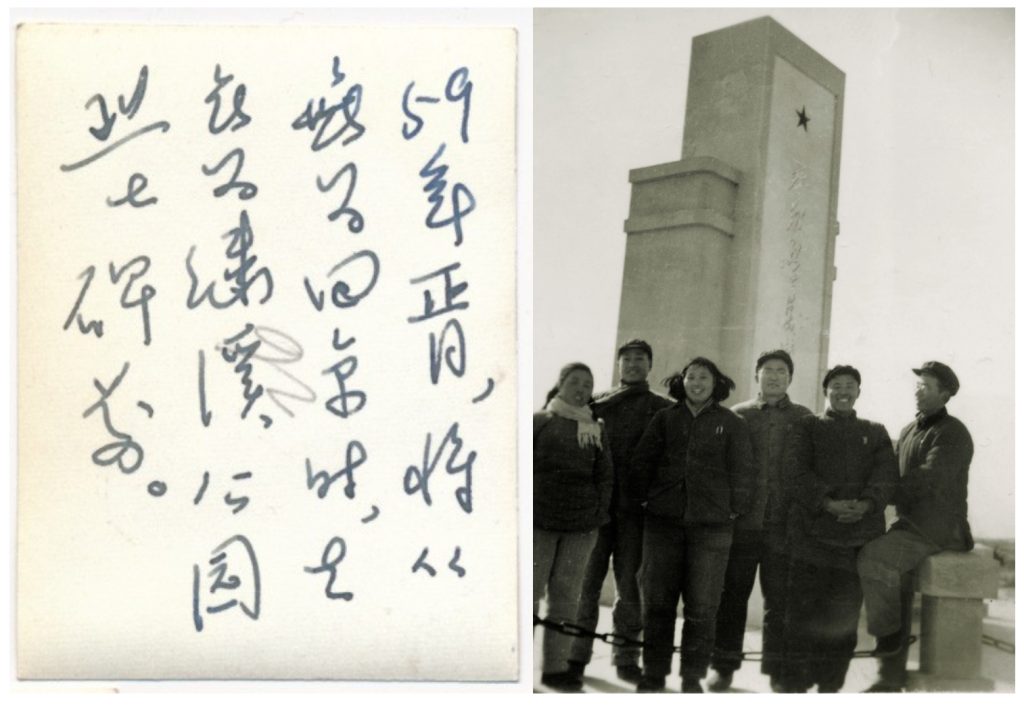
When I returned from Anhui in 1959, Liu Zhiyan asked me: “What sort of things do you think you might have learned from your experiences?” I replied: “I arrived at the following conclusion: whenever my views on an issue do not correspond with those of the party organisation or the Party Central, it is certain that I am mistaken. “Don’t be so precious [矯情],” was his response. In 1967, when I was locked up in a “Cow Shed” [a make-shift prison for ideological enemies], Red Guards of the Sichuan Rebels searched me out and demanded that I denounce Liu Zhiyan. They told me that he had been labelled an “Anti-Party Element” and had committed suicide. (“Interview with Bao Tong,” recorded 2018-2020, edited)
After the Great Leap Forward, for three years in a row tens of millions of people starved to death. This was neither as a result of natural disasters nor due to the fertility or otherwise of the soil. After this, we could observe a particular pattern: wherever the “Three Red Flags”[19] were hoisted the highest, wherever the Anti-Rightest campaign proved the most intense and wherever production figures were most exaggerated, those were precisely the places where casualty figures peaked. How can you explain this? Exaggerated production figures led to false reporting, and when the state requisitioned grain in accordance with the false reports, the amount of grain being requisitioned invariably exceeded the normal rations consumed by the peasants of that area, this then led to shortages and soon famine stalking the land, resulting in numerous deaths. For this reason we can say that without doubt tens of millions of people starved to death due to politics. I have never undertaken a specific study of exactly how many people died nationwide but I have heard two different figures: (1) In 1962, Li Xiannian told Wang Weigang 王維綱, a member of the Central Supervisory Committee, that he estimated that: “The total deaths in Anhui Province were between 3 and 5 million.” I was told this by a fellow cadre in the research office who had accompanied Wang Weigang to Anhui on an inspection tour; (2) The population of Guangshan County in Henan Province in 1958 before the Great Leap Forward had been 300,000. By the end of 1960 this figure had fallen to 100,000, a decline of two thirds. This figure surfaced when the Xinyang Problem was exposed.[20] (Autobiography)
[Note 19: The “Three Red Flags” 三面紅旗 or banners that represented the party’s policies in the late 1950s were: the General Line, the Great Leap Forward and the People’s Communes.]
[Note 20:It is estimated that in the Xinyang district of Henan, over a million people died of starvation as a direct result of the policies of the Great Leap Forward and the grossly inflated reports of grain yields.]
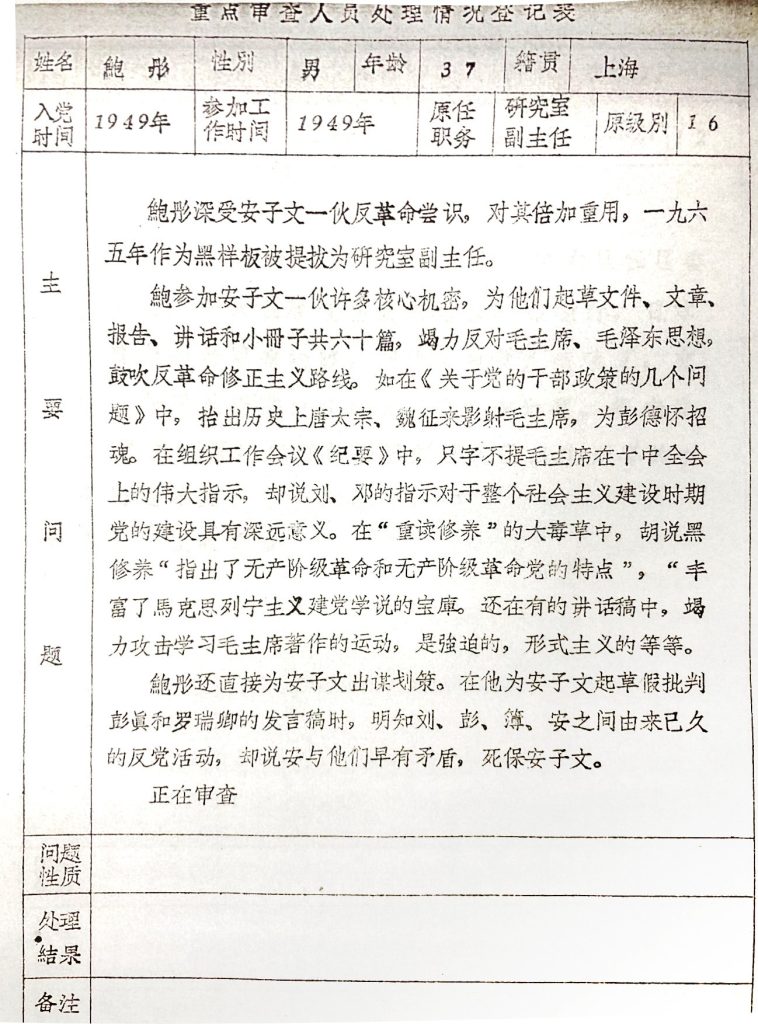
All of a sudden, in 1963, those of us working in the Organisation Department were told about a “Report on the Deeds of Lei Feng.” This left a deep impression on me. It was quite without precedent, I thought, for someone to go on and on about the good deeds they had performed, to pre-emptively congratulate themselves on their good deeds, to have photographs taken of themselves posing as a do-gooder and to brag about it all. Later, of course, similar stories circulated about Chen Yonggui 陳永貴 (1915-1986),[21] and increasingly large numbers of similar “heroes” cropped up. The process whereby the Communist Party became completely habituated to telling lies was a slow and steady one. (“Interview with Bao Tong,” recorded 2018-2020, edited)
[Note 21: Chen Yonggui was an illiterate peasant who because of his leadership of the model commune Dazhai 大寨 during the Cultural Revolution was elevated to the Party’s Politburo. Following Mao’s death in 1976, Chen was gradually side-lined and he resigned from his post in 1980.]
***
***
End of Part III
***
Source:
- 鮑樸,坦蕩怡天壽——我的父親鮑彤,《議報》,2022年11月17日