

Contra Trump
親者痛,仇者快
Chinese reading the document will say, our time has come. Russians reading the document will say: we can still rebuild our old empire. Europeans reading the document will ask themselves what strange act of projection is behind those words about ‘civilizational erasure.’ Is this bullying regime actually confessing that this fate, projected onto Europe, is what it fears most for itself?
— Michael Ignatieff
In this chapter of our Contra Trump series we feature four responses to the National Security Strategy of the Trump administration. The Chinese rubric of the chapter — 親者痛,仇者快 qīn zhě tòng, chóu zhě kuài — may be rendered as ‘allies will shudder, enemies rejoice’.
See also Olga Lautman, Trump Has Turned the U.S. Into Russia’s Newest Satellite State, 6 December 2025; and, America’s Foreign Policy Now Aligns With Russia, Unmasking Russia, 7 December 2025. In China Articles, Matt Turpin offered a far more generous analysis of the ‘Trump doctrine’ one which we presume will also meet with the approval of the loquacious claque of authoritarian-adjacent, latter-day political pilgrims members of which, for the most part, jet in to the PRC from the United States and beam out the ‘good news’ about Beijing being ‘the future’ via clickbait rich podcasts, substack essays and vertical videos.
豬八戒照鏡子,裡外不是人。
— Geremie R. Barmé
Editor, China Heritage
8 December 2025
***
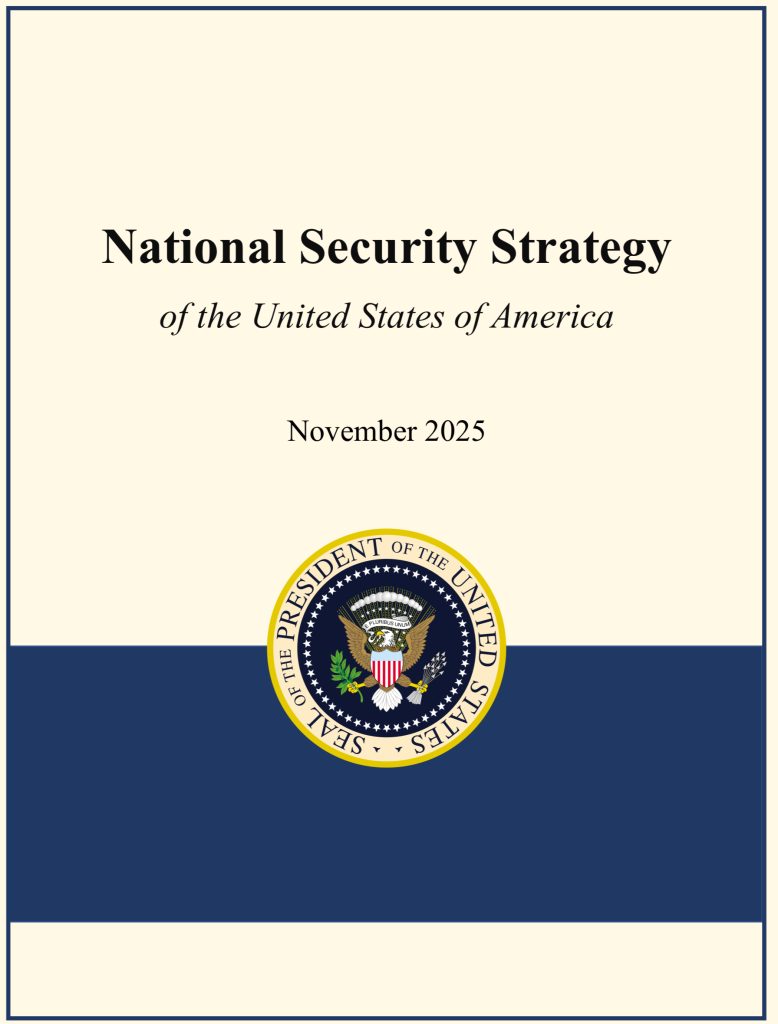
Trump’s Unserious — But Dangerous — National Security Strategy
Trump’s National Security Strategy conveys a flawed, incoherent, and deeply dangerous view of the world and America’s role in it. America’s allies will shudder; its enemies will rejoice.
Ivo Daalder
Ever since Congress passed the Goldwater-Nichols Act in 1986, incoming administrations have issued a new National Security Strategy. Many of these documents are mundane statements of administration priorities and most read like the committee-drafted document they usually are. Once issued, they tend to be quickly forgotten.
The same may well be true for President Donald Trump’s second National Security Strategy, which was released by the White House late Thursday night [4 December 2025] without notice or fanfare. But that would be a mistake. For this document, though disorganized and filled with platitudes and Trumpian boasting, demonstrates how far this administration has traveled from what used to be the foreign policy mainstream—long supported by Republicans and Democrats alike—and even from Trump’s first National Security Strategy issued in December 2017. Instead, the document paints a picture of a world that America’s adversaries will embrace and its allies, friends, and partners will abhor, if not fear.
Much of the new strategy document is an unsuccessful attempt to put a veneer of conceptual coherence around what has been a mostly incoherent and chaotic foreign policy. But there are at least three elements of the strategy that underscore the radical departure of Trump’s second term foreign policy from the post-1945 American norm: the pivot to the Western Hemisphere, the denunciation of Europe, and the elevation of profits over principles.
The Hemispheric Pivot
Trump loves the 19th century. He loves James Monroe, whose doctrine barring foreign interference in the Western Hemisphere bears his name. He loves William McKinley for the tariffs he imposed on foreign trade. He loves Teddy Roosevelt, who embarked on forceful expansion in the Hemisphere, including building the Panama Canal.
Now, in the second quarter of the 21st century, Donald Trump wants to return to the 19th century and make the Western Hemisphere his own:
After years of neglect, the United States will reassert and enforce the Monroe Doctrine to restore American preeminence in the Western Hemisphere, and to protect our homeland and our access to key geographies throughout the region. We will deny non-Hemispheric competitors the ability to position forces or other threatening capabilities, or to own or control strategically vital assets, in our Hemisphere. This “Trump Corollary” to the Monroe Doctrine is a common-sense and potent restoration of American power and priorities, consistent with American security interests.
To be clear, this “Trump Corollary” goes well beyond the Monroe Doctrine, which was a defensive declaration that the United States would oppose European colonization and intervention in the Hemisphere in return for the United States staying out of European affairs. Instead, the “United States must be preeminent in the Western Hemisphere as a condition of our security and prosperity—a condition that allows us to assert ourselves confidently where and when we need to in the region.” Irrespective, or so it is implied, whether other states in the region concur or not.
That, of course, is a fundamental departure from the idea, enshrined in the UN Charter and the basis of international relations ever since 1945, that states are sovereign and must respect the sovereignty of others. Indeed, while the document plays lip service to the primacy of the nation state and the importance of state sovereignty, it pointedly notes that the “outsized influence of larger, richer, and stronger nations is a timeless truth of international relations.” In other words, preeminence justifies dominance.
To underscore its dominance, the strategy document argues for readjusting the US military posture to bolster America’s military presence in the region in order to “secure borders and defeat cartels” through the “lethal use of force” rather than “the failed law-enforcement strategies of the last several decades.” This explains the deployment of troops at the border and the large military buildup in the Caribbean Sea over the last few months. The larger military presence is also necessary for “establishing and expanding access in strategically important locations.” Though the document does not mention any specifics, this is no doubt a reference to the Panama Canal and Greenland, both of which Trump has claimed are of strategic importance to the United States.
Whoever thought the era of imperialism had come to an end will be disappointed by its naked return in this new strategy.
It wasn’t all that long ago that presidents referred to America’s relations with its European partners as “the cornerstone of US foreign policy.” No more. Instead, the strategy document paints a dark, pessimistic picture of our European allies. Pointing to the prospect of “civilizational erasure,” the document states:
The larger issues facing Europe include activities of the European Union and other transnational bodies that undermine political liberty and sovereignty, migration policies that are transforming the continent and creating strife, censorship of free speech and suppression of political opposition, cratering birthrates, and loss of national identities and self-confidence.
It’s an extraordinary indictment, all the more so because little of it is true. Most European countries (with the exception of Hungary and some others that Trump and his supporters have long embraced) score far higher than the United States on Freedom House’s ranking of political and civil liberties. The foreign-born population in the United States is larger than in most European countries. Press freedom in most EU countries is far greater than in the United States according to the Press Freedom Index. And anyone who knows anything about Europe’s 20th century history will know the extraordinary contribution the European Union has made to Europe’s peace and prosperity since the end of World War II—a reality recognized in 2011 when the EU received the Nobel Prize for Peace.
While Europe has its problems—including a stagnant economy, political divisions, and lack of competitiveness—it’s a far cry from the dilapidated picture painted by the Trump National Security Strategy. The last thing it needs, however, is what the document offers:
American diplomacy should continue to stand up for genuine democracy, freedom of expression, and unapologetic celebrations of European nations’ individual character and history. America encourages its political allies in Europe to promote this revival of spirit, and the growing influence of patriotic European parties indeed gives cause for great optimism. Our goal should be to help Europe correct its current trajectory.
Europe doesn’t need civilizational lectures from an administration that has eroded the rule of law at home and abroad, treated immigrants as animals, called political opponents “domestic extremist organization,” halted all refugee admissions except for white Afrikaners it falsely claims are victims of genocide, and espoused a racist, white, Christian nationalism.
But the strategy document’s attack on Europe is not only ideological. It’s also strategic. Russia’s invasion of Ukraine poses the gravest threat to European security since at least the end of the Cold War. The reason is clear: Vladimir Putin’s Russia has resorted to using force to try and undo the post-Cold War order—an order based on the sovereignty and independence of all European states. The document, however, is silent on Russia’s quest—indeed, it is silent on the Russian threat. Instead, it argues that the problem stems from Europe’s lack of self-confidence and its supposed undermining of democracy at home. In yet another eye-popping claim, the document asserts:
The Trump Administration finds itself at odds with European officials who hold unrealistic expectations for the war perched in unstable minority governments, many of which trample on basic principles of democracy to suppress opposition. A large European majority wants peace, yet that desire is not translated into policy, in large measure because of those governments’ subversion of democratic processes.
It then suggests that it is a “core interest of the United States to negotiate an expeditious cessation of hostilities in Ukraine” and that the best way to do that is for the United States to mediate between Europe and Russia. Ending the war will enable Washington to “reestablish strategic stability with Russia.” Nowhere does the strategy document suggest that denying Russia its claims or its ability to reap gains from the use of force would have to be a precondition for strategic stability.
All of this puts the Trump administration’s latest efforts to negotiate an end to the war in Ukraine—including the 28-point plan that the administration originally presented to President Volodymyr Zelensky as a fait accompli—in a very different light. Trump blames Europe, not Russia, for the war. He seeks an end to the war that Russia can live with and Ukraine and Europe will have to accept, whether they like it or not.
In all, the new strategy document makes clear that the United States no longer believes in an alliance based on common interests, values, and threats. It represents the end of the transatlantic relationship as we have known it for the past 80 years.
Profit Over Principles
For more than 80 years, successive presidents and administrations have justified their international engagement on the basis of a core set of values and principles that they believed were the foundation for peaceful relations among states. Freedom. Democracy. Human Rights. These were what Americans cared about most. And as the largest and most powerful nation on earth, a nation founded on the precept that its purposes rested on the protection and advancement of “life, liberty, and the pursuit of happiness,” America had a special role to play to defend and advance these principles across the globe. That is what it meant to be the Leader of the Free World.
But in Trump’s vision of America, the United States is no longer a Leader. Nor is there any longer a Free World. Instead, what matters most is to make money. Aside from its ideological assault on Europe, the new strategy is all about profits, not principles.
This new direction is most evident in its Hemispheric policy of regional preeminence. The goal is to use America’s domination to advance US business interests.
The U.S. Government will identify strategic acquisition and investment opportunities for American companies in the region and present these opportunities for assessment by every U.S. Government financing program. […] The terms of our agreements, especially with those countries that depend on us most and therefore over which we have the most leverage, must be sole-source contracts for our companies. At the same time, we should make every effort to push out foreign companies that build infrastructure in the region.
But it isn’t just in the Americas that the administration seeks economic advantage or views the region in terms of economic gains. In Africa, the strategic document proposes a transition from providing aid to focusing on trade and investment, especially with countries that will “open their markets to US goods and services” or offer investment opportunities in “the energy sector and critical mineral development.” The Middle East, with energy needs met increasingly by production at home, “America’s historic reason for focusing on the Middle East will recede.” It no longer is a source of conflict, but rather “a source and destination of international investment.”
Even in Asia, which the document recognizes as “the next century’s key economic and geopolitical battleground,” the bulk of its focus in the region is on economic opportunities and protection. Taiwan is important because of its semiconductors and protection of vital sea lanes, not because it is a vibrant democracy that the United States has assisted and protected for decades. Keeping the South China Sea open for navigation is similarly important for economic reasons, rather than the geostrategic reason of preventing China’s dominance of the Indo-Pacific. Even the relationship with China, which both Trump in his first term and President Joe Biden identified as the greatest strategic competitor of the United States, the new strategy document is silent on the strategic threat China poses and instead focuses on building “a genuinely mutually advantageous economic relationship with Beijing.”
An Unserious Document
In all, the new National Security Strategy is a deeply unserious document—befitting an unserious president. But it is no less important—or dangerous—for that. It at once throws our longstanding allies (who, even the document admits, can help America achieve some of its goals and are needed to help deter threats to American interests) under the bus. And it does away with a broad, bipartisan consensus—developed in no small part by the first Trump administration’s policies—of the need to compete politically, technologically, militarily, and economically with China. It is silent on the increasingly threatening ties between China, Russia, Iran, and North Korea. And it abandons any thought that the values and ideals that made America great and respected need to be held up, protected, and advanced.
In short, this document will deeply alarm America’s allies and strongly encourage its adversaries.
***
Source:
- Ivo Daalder, Trump’s Unserious — But Dangerous — National Security Strategy, American Abroad, 7 December 2025
***
Trump’s Security Strategy Is Incoherent Babble
But mixed in with the ranting are three valuable points.
Eliot A. Cohen
5 December 2025
The Trump administration’s 2025 National Security Strategy has landed, with not so much a thud as a kind of greasy flutter. Most of the document consists of bombast, sycophancy, lies, inconsistencies, and grotesque self-contradictions. But it also—and this is something missed by the deservedly contemptuous reviews it has received—clarifies some policy preferences and touches on real problems. Like the babble of a thrashing sleeper who alternates between fantasy-laden dreams and cold-sweat nightmares, it is a window into disturbing encounters with the world’s realities.
Once upon a time, these documents were drafted by intellects such as Henry Kissinger and Zbigniew Brzezinski—both, notably, refugee immigrants. The reports they produced were reasoned, sometimes anodyne, but usually consistent, thoughtful, and historically informed. This NSS seems to have been put together by lickspittles with literary aspirations but no discernible literary skills. Only a disabled cringe reflex, for example, could have permitted the claims that Trump alone has rescued the United States from the machinations of American foreign-policy elites, let alone that he has brought peace (not merely cease-fires) to India and Pakistan or Israel and Iran, or “single-handedly reversed more than three decades of mistaken assumptions about China.” And how would a junior-high English teacher react to the spectacular metaphor invoking Trump’s ability to “surgically extinguish embers of division between nuclear-capable nations and violent wars caused by centuries-long hatred”?
This NSS is a document that can soar only so far as pedantry (strategy is about ends and means—who knew?), and it is oblivious to inconsistency. On the one hand, the administration proclaims a pious and restrained respect for other countries’ customs, beliefs, and political cultures; on the other hand, it has the goal of coercing Europe back to its civilizational roots as understood by the White House’s resident cultural savants. It celebrates American soft power, which is a bit odd given Trump’s unceasing attempts to shut down Voice of America and thereby clear the way for well-funded and sophisticated Chinese and Russian propaganda. It blithely careens between swagger about America’s incomparable strength and terror about its narrowly averted collapse in recent years. It is, in short, an embarrassing mess of a state paper, which appropriately begins with a few boasts from Trump and ends without a conclusion, petering out as it talks about Africa.
But it also has in it three ideas that, stripped of the rants and the brownnosing, are important and at least partially true. The first is that the United States has tended to ignore the Western Hemisphere until a crisis (the Cuban revolution or the near collapse of Colombia in the 1980s and ’90s) causes it to look in its backyard. At the State Department, the power regional bureaus are Europe and the Middle East, followed by Asia; Latin America and Africa are often afterthoughts.
The prescriptions are predictably loopy. What the NSS terms the Trump Corollary to the Monroe Doctrine is nothing more than an assertion of the right to interfere with any government we dislike. Indeed, I doubt that the administration has any idea what the Monroe Doctrine was originally about—a rejection of European attempts to establish or reestablish colonial rule that was, however, enforceable only by the Royal Navy rather than by the meager American military establishment of the 1820s. There are no real policies here other than deals—nothing about building consensus, establishing deeper ties, or strengthening democratic institutions through, say, the newly renamed Donald J. Trump Institute of Peace. Nonetheless, the White House is right to call attention to America’s own backyard.
On Africa, too, which is very nearly an afterthought in the document, there is a kernel of sense: shifting from understanding the continent primarily through the perspective of development aid to one focused on commerce. Although this undervalues some programs—such as the tremendously successful President’s Emergency Program for AIDS Relief (PEPFAR), launched by President George W. Bush—it also captures an important idea. For that matter, the administration’s decision to move USAID to the State Department was an entirely sensible move aimed to lend at least some coherence to where and why the United States doles out taxpayer dollars to foreign entities.
And on Europe, the NSS is uncomfortably in the right ballpark in pointing out the challenge of mass migration. If there is one subject that populists in the United States and Europe fully understand that most progressives do not, it is that largely uncontrolled flows of migration produced a crisis in the United States, and far more so in Europe. The White House goes too far in suggesting the probable extinction of European culture, but it has put its finger on a real problem.
This is a populist document. It expresses an undifferentiated loathing of traditional foreign-policy elites, which the administration has shunned. Its intellectual incoherence is that of the angry autodidact, the anti-vaxxer activist, and the anti-Biden conspiracy theorist. This helps account for its ambivalence. The document, like the administration, is split between internationalist and isolationist impulses—offering a commitment to American alliances and a forward presence in Asia on the one hand, and indulging proclivities for “America First” isolationism on the other. In some respects, the NSS reflects the peculiar nature of the Trump coalition, which is composed of different and occasionally mutually antagonistic factions, and above all of the muddled enthusiasms, resentments, insecurities, and vanities of the president himself.
But it also reflects a larger mood. The contempt for foreign-policy elites is nothing new: Ben Rhodes, Barack Obama’s speechwriter who, in his early 30s, had an advanced degree in creative writing and little expertise in foreign policy, famously sneered at the establishment as “The Blob.” In retrospect, the Biden administration may have been the last gasp of traditional foreign-policy experts such as Deputy Secretary of State Kurt Campbell and Director of Central Intelligence William Burns. One cannot count on a Democratic Party ever more influenced by its progressive wing to be any more centrist or thoughtful than the Trump administration, although it may have somewhat better manners. That is a depressing prospect in a dangerous world.
The one thing the NSS does not present is a coherent picture of America’s adversaries. China is portrayed chiefly as a commercial rival, Russia as a Eurasian power that requires a vague kind of stability, Iran as a menace that has been definitively dealt with by B-2 bombers. Jihadist movements and North Korea are either touched on in passing or ignored altogether.
Strategy for national security is necessary because America has both opponents and outright enemies, who have to be studied and understood if we hope to thwart, contain, or transform them. If we know nothing about them or have comforting illusions about them, or can think about them only in clichés and slogans, the result will be not strategy but mere expressions of an unchained foreign-policy id. Unfortunately, however, judging by both the administration’s behavior and this document, that is what we have before us.
***
Source:
- Eliot A. Cohen, Trump’s Security Strategy Is Incoherent Babble, The Atlantic, 5 December 2025

***
Europe’s “Civilisational Erasure”
The US National security Strategy and the End of the West
Michael Ignatieff
The National Security Strategy of the United States, released on Friday, under the President’s gigantic signature, may not predict the erratic path he will follow in the years left to him in office but it tells you all you need to know about what the hegemon and his clique really think about the people America once called friends.
Europe once was such a friend. It belonged, with the United States, in a partly imaginary, partly real place called ‘the West.’ This place, first dreamed of in ancient Greece, was anchored in the minds of generations on both sides of the Atlantic by leaders, going back to Churchill and Roosevelt, who used certain words—democracy, freedom and human rights—to express what the West believed, and certain other words, like tyranny, to define what the West stood against. In the US National Security Strategy, all of these words and all of the mutually binding moral commitments they implied have disappeared. The West is gone too, and the belief, so dear to Churchill and Roosevelt, that America’s vision of freedom began its life in the old continent’s traditions of liberty, is waved aside as a ‘sentimental’ fiction.
Indeed, the strategy document describes Europe as a burnt-out case, imprisoned in memory of past glories and incapable of understanding that it faces ‘civilizational erasure.’ A phrase such as this, shocking in its contempt, needs to be unpacked. Europe faces erasure, first of all, because America has declared the ‘West’ no longer exists. There is only one world historical actor in this document. It is America, the ‘exceptional’ nation, reclaiming its destiny. It is no longer the destiny of a light to the nations, as that city on a hill evoked by the Pilgrims. In place of these messianic visions is nothing but a fierce desire to be feared. An America that wants to be feared can’t afford to be swayed by the sentimental ties that once linked America to its European origins.
Europe faces ‘civilizational erasure’, secondly, because its nation states have surrendered their national sovereignty to the European Union. The EU is one of those international organizations like the UN which neuters the independence of nation states. The American Gulliver is throwing off the ties of international comity that once held it down, while Europe’s nations have allowed transnational leading strings to tighten ever further.
The third source of civilizational erasure, says the US document, is immigration. An American administration that might have welcomed the fact that Europe’s multiculturalism now mirrors America’s own instead condemns Europe for policies diluting the ethnic, national and religious identities of its peoples. The report predicts a near term future when a majority of the population in European states become ‘non-European’. When that happens the ties that link NATO allies in shared values may snap altogether. The ‘strategy’ here is clear: instead of taking responsibility for its own contempt, the US regime blames migration for the erasure of common bonds.
Civilizational erasure, finally, will follow, says the document, from the tyranny of liberal political correctness in European politics and the vain liberal struggle against the populist right. In the national security strategy, the ‘patriotic parties’ of the hard right, are Europe’s only true defenders. A new axis is forming—Orban in Budapest, Meloni in Rome, AfD in Berlin, Nawrocki in Warsaw, Wilders in The Hague, Bardella and LePen in Paris and Farage in London. Now that America has declared them to be Europe’s future, it hopes they will advance to destroy the liberal project—multiculturalism and social welfare at home, multilateralism and international law overseas.
When the Vice President tried out these themes at the Munich security conference in February, his astonished audience may have thought the speech was just a trial balloon by a bumptious amateur. Now Vance’s polemic has received the imprimatur of official national policy. The national security strategy explicitly replaces common adherence to democracy with common adherence to hard right ideology as the sole remaining criteria for whom America defines as a friend in Europe.
Europeans will doubtless be delighted to learn that US national policy wants to save Europe from ‘civilizational erasure’ before it is too late. Salvation will come, we’re told, in the form of American lectures on Europe’s democratic failings:
“We will oppose elite-driven, anti-democratic restrictions on core liberties in Europe, the Anglosphere, and the rest of the democratic world, especially among our allies.”
So Canada, Australia, Brazil, and other democratic allies can expect lectures on the rule of law and free speech from a regime whose attack on these principles gathers pace at home. At the same time, the US will say nothing disobliging about the domestic arrangements of the Gulf States, China, Russia—to name but three of the world’s tyrannies. The document notices this apparent contradiction and sweeps it aside:
“We recognize and affirm that there is nothing inconsistent or hypocritical in acting according to such a realistic assessment or in maintaining good relations with countries whose governing systems and societies differ from ours even as we push like-minded friends to uphold our shared norms, furthering our interests as we do so.”
What looks like double standards in the treatment of democracies and tyrannies disappears if you accept the hard power logic of the document. In the vision at the heart of the US national security strategy, the democracies of the world are weak, divided and economically fragile. Europe, especially, has no pole position in any of the leading technologies of the future. The tyrannies, on the other hand, are strong. The Gulf States are rich. The Russians may lack any chance to create the technologies of tomorrow, but they have nuclear weapons. The Chinese have a huge population and a regime that doesn’t budge when it is shoved. It follows, therefore, the US feels free to hector its former allies, while colluding and conspiring with the tyrannies.
The same hard power logic implies a world divided into blocs and spheres of influence. The Americans claim their hemisphere as their own backyard and will insist that US companies get no-bid contracts from their client states in the region. Imagine, if you can, how a President of Mexico or a Prime Minister of Canada will react when they are told they must contract with US companies and with the President’s plutocratic friends. If the Western Hemisphere is American, then East Asia is Chinese, and Europe is discarded as an abandoned netherworld, a cluster of declining, over-regulated democracies at the mercy of the Russian-Chinese Eurasian hemisphere of tyranny on their eastern frontier. If the national security strategy accomplishes nothing else, this picture of Europe’s future should awaken her leaders to the fate they must, at all costs, avoid.
In a document so determined to make the world fear America, what is striking is its simultaneous confession of weakness. America, it proclaims, simply cannot afford “a massive welfare-regulatory-administrative state” at home and a “massive, military, diplomatic, intelligence and foreign aid complex” overseas. It can’t be the Atlas who holds up the world. To say that you want to be feared, while beating retreat, is not credible. Chinese reading the document will say, our time has come. Russians reading the document will say: we can still rebuild our old empire. Europeans reading the document will ask themselves what strange act of projection is behind those words about ‘civilizational erasure.’ Is this bullying regime actually confessing that this fate, projected onto Europe, is what it fears most for itself?
***
Source:
- Michael Ignatieff, Europe’s “Civilisational Erasure”, 7 December 2025
***
At a moment in American politics in which Trump has very low approval ratings, Democrats are winning elections, many predict a blue wave in 2026 & a Democratic president in 2028, and a solid majority of Americans support NATO, it would be imprudent to get too fatalistic about the death of Transatlantic relations because of an incoherent National Security Strategy written by a small group in the Trump administration. Play the long game.
— Michael McFaul, former U.S. ambassador to Russia
***
