
Contra Trump
大撒幣
As an estimated seven million Americans took part in the No Kings protests on Saturday 18 October 2025, the country’s president, Donald J. Trump uploaded a protest of his own. An AI-generated short video released both on Trump’s social media platform and by the White House, featured Trump wearing a crown and with his face partially covered by an oxygen mask, piloting a fighter jet which releases excrement on the protesters to the sounds of Danger Zone by Kenny Loggins, music featured in the film Top Gun (see below; Loggins protested against the use of his music in the divisive video). The twenty-three-year-old Democratic Gen Z influencer Harry Sisson is featured prominently, and is covered in poop in seconds.
“Can a reporter please ask Trump why he posted an AI video of himself dropping poop on me from a fighter jet?” Sisson posted on X on Sunday. “That would be great thanks.”
US Vice President Vance felt the need to chime in: “I’ll ask him for you Harry.”
***
***
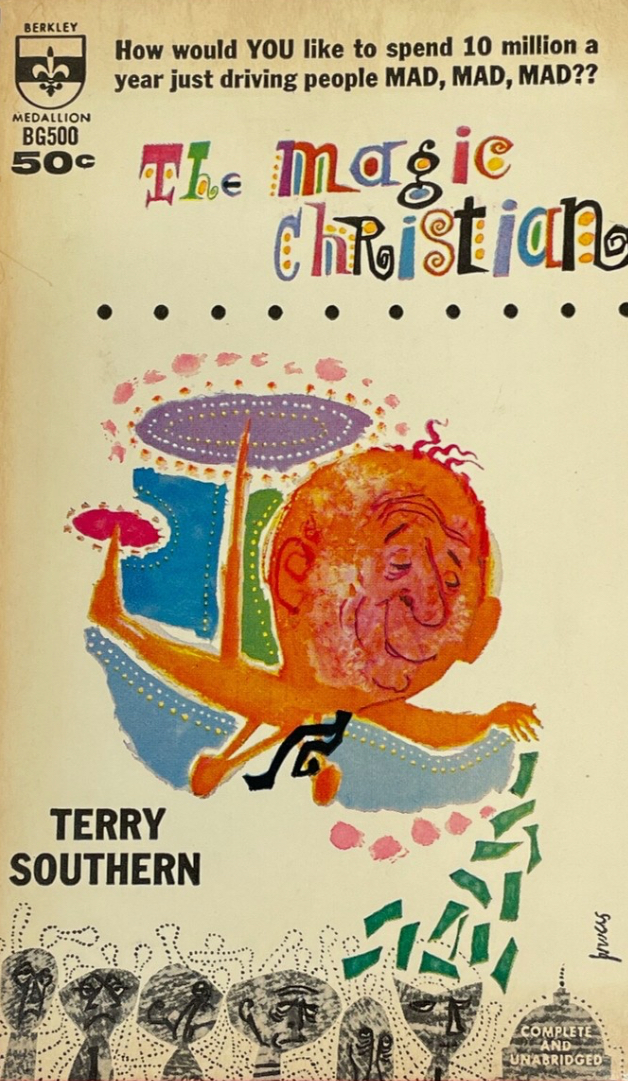
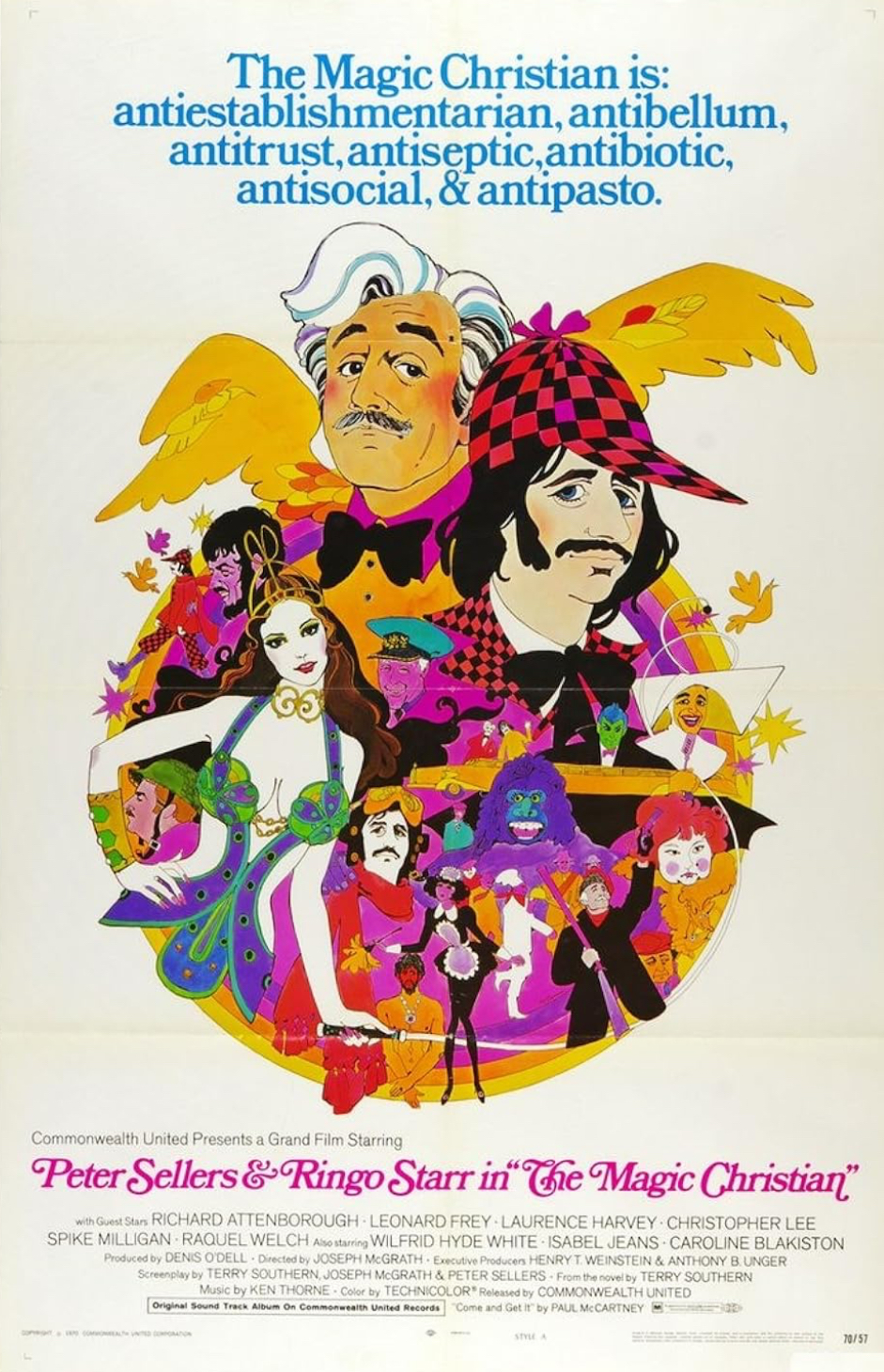
The incident — merely the latest example of juvenile villainy from the American government — brought to mind The Magic Christian, a novel by Terry Southern, that I read in my teens, the film adaptation of which I saw when it was released in Australia in 1970.
The Magic Christian advertises itself as being a story of how ‘the world’s richest man and his adopted hobo son set out to test the limits of human vanity and greed through a series of “money games”.’ The back of my copy of the novel carried the following blurb:
THE RICHEST MAN IN THE WORLD!
Guy Grand was a billionaire with a very special purpose. His whole life was dedicated to the proposition that all men and women are equal in depravity and vice. With the greatest fortune in the world at his disposal, he set out to prove that there is nothing so demanding or degrading that someone won’t do it for money.
His wildly, brutally sadistic exploits make for one of the funniest and most disturbing novels to appear in recent years.
As part of our Contra Trump series, and to acknowledge the escalation of Trumpista scatology, we offer an excerpt from the novel and a scene from the film adaptation, which features Peter Sellers and Ringo Starr.
The ultimate adventure of the picaresque hero of the book remodels a luxury liner, which he christens the S.S. Magic Christian. The ship caters exclusively to the super-wealthy upon whom Guy Grands inflicts various indignities. The palatial interiors of the vessel gradually take on the appearance of a ghetto and anarchist graffiti mysteriously appear on the walls:
DEATH TO RICH!
BLOW UP U.S!
— The Magic Christian, p.118
Terry Southern was soon invited by Stanley Kubrick to work on the screenplay of Dr. Strangelove or: How I Learned to Stop Worrying and Love the Bomb (1964).
***
The rubric of this chapter is 大撒幣 dà sǎ bì, ‘cash splash’ or ‘big spender’. The expression is also a homophone for ‘mega fuck wit’ 大傻屄 dà sǎ bī, a popular sobriquet for Xi Jinping, a Chinese leader known for courting third-world allies with lavish loans, son et lumière extravaganzas, OTT banquets and exorbitantly expensive liquor (see The Absurdities of China’s Locked-in Syndrome).
As the No Kings protesters filled the streets of American cities, Trump took time out from shit-posting to oversee the demolition of the eastern façade of the White House in preparation for the construction of a $250 million ballroom. His opponents then took to counter-shit posting short videos of excrement being dumped on the Leader of the Free World while he was golfing, Mar-a-Lago being strafed by poo and scenes of the 6th of January rioters being inundated with scheiße.
— Geremie R. Barmé
Editor, China Heritage
21 October 2025
***
FREE $ HERE
Grand’s own idea of what he was doing—”making it hot for people”—had formed crudely, literally, and almost as an after-thought, when, early one summer morning in 1938, just about the time the Spanish Civil War was ending, he flew out to Chicago and, within an hour of arrival, purchased a property on one of the busiest corners of the Loop. He had the modern two-story structure torn down and the debris cleared off that day-that very morning, in fact—by a demolition crew of fifty men and machines; and then he directed the six carpenters, who had been on stand-by since early morning, when they had thrown up a plank barrier at the sidewalk, to construct the wooden forms for a concrete vat of the following proportions: fifteen feet square, five feet deep.
This construction was done in an hour and a half, and it seemed that the work, except for pouring the concrete, was ended; in fact the carpenters had put on their street clothes and were ready to leave when, after a moment of reflection, Grand assembled them with a smart order to take down this present structure, and to rebuild it, but on a two-foot elevation giving clearance beneath, as he explained to the foreman, to allow for the installation of a heating apparatus there.
“That’ll make it hot for them,” he said—but he wasn’t speaking to the foreman then, nor apparently to anyone else.
It was mid-afternoon, and collecting from the flux of the swollen summer street were the spectators, who hung in bunches at the sturdy barrier, gatherings in constant change, impressed in turn by the way the great man from the East snapped his commands, expensively dressed as he was, shirt turned back at the cuff.
And when the work was going ahead correctly, Grand might give the crowd a moment of surveillance from where he stood in the center of the lot, finally addressing them, hands cupped to his mouth as if he had to shout—though, actually, they were only a few yards away.
“Tomorrow…” he would say, “… back … tomorrow. Now … getting … it ready!”
When an occasional wiseacre could get his attention and attempt some joke as to what was going on there beyond the barrier, Grand Guy Grand would smile wearily and shake a scolding finger at him.
“Now … getting … it … ready,” he would shout slowly, or something else equally irrelevant to the wiseacre’s jibe; but no one took offense, either because of not understanding or else because of the dignity and bearing of the man, and the big diamond he wore at his throat.
Another contractor, three workers, a truck of sand and gravel, and six sacks of quick-drying cement arrived at the working site at two o’clock, but were forced to wait until the new forms were complete. Then a sheet of metal was lowered into place and the concrete was poured into the forms. Under Grand’s spirited command, it was all so speedily done that well before dusk the work was ended, including the installation of a great gas burner there, star-shaped with a thousand dark jets, like a giant upturned squid stretched beneath the structure. It was apparent now that when the board forms were removed, the whole would resemble a kind of white stone bath, set on four short columns, with a heating apparatus beneath, and small ramps leading up the vat on each of its sides.
Before dinner Guy Grand completed arrangements begun earlier in the day with the Chicago stockyards: these provided for the delivery of three hundred cubic feet of manure, a hundred gallons of urine, and fifty gallons of blood, to an address in the suburbs. Grand met them there and had the whole stinking mess transferred to a covered dump truck he had purchased that morning. These arrangements cost Grand a pretty penny, because the stockyards do not ordinarily conserve or sell urine, so that it had to be specially collected.
After securing the truck’s cover, Grand climbed into the cab, drove back towards the stockyards and parked the truck there, where the stench of it would be less noticeable. Then he took a taxi into town, to the near North Side and had a quiet dinner at the Drake. At nine o’clock, while it was still light, he returned to the working site, where he was met by some of the crew, and saw to the removal of the board forms and the barrier. He inspected the vat, and the burner below—which he tested and found in good working order. Then he dismissed the crew and went back to his hotel.
He sat at his desk writing business letters until his thin gold wrist-clock sounded three A.M. Exactly then he put away his writing things, freshened himself up, and, just before leaving the room, paused near the door and collected a big leather brief case, a gas mask, a wooden paddle, a bucket of black paint, and an old, stiff paintbrush. He went downstairs and took a cab out to the place where he had parked the dump truck. Leaving the cab, he got into the truck and drove back to the working site. There he backed the truck carefully up one of the ramps and then emptied all that muck into the vat. The stench was nearly overpowering, and Grand, as soon as he had parked the truck and gotten out of it, was quick to don the gas mask he had brought.
Stepping up one of the ramps, he squatted on the parapet of the vat and opened the brief case, out of which he began taking, a handful at a time, and dropping into the vat, ten thousand one-hundred-dollar bills, slowly stirring them in with his wooden paddle.
And he was in this attitude, squatting at the edge of the vat, gas mask covering his face, stirring with his paddle and dumping bills into the muck, the work only half begun, when a passing police patrol car pulled up to investigate the activity and, above all, the stench. But before the officers could properly take account, Grand had closed the brief case, doffed his mask, given them five thousand dollars each, and demanded to be taken at once to their precinct captain. After a few hushed words between them, and a shrugging of shoulders, they agreed.
At the station, Grand spoke privately with the captain, showing him several business cards and explaining that it was all a harmless promotion stunt for a new product. “Naturally my firm is eager to cooperate with the authorities,” he said, and handed the captain twenty-five thousand. And so it was finally agreed that Grand might return to the site and proceed, as long as whatever he was doing did not involve criminal violence within the precinct. Moreover, while the captain could make no definite promise about it, he was attentive enough to Grand’s proposal of an additional fifty thousand on the following noon if the police would be kept away from the site for a few hours that morning.
“Think it over,” said Grand pleasantly. “Better sleep on it, eh?”
Back at the site, Grand Guy donned his mask again, and dumped the remaining contents of the brief case into the vat. Then he stepped down, opened the can of paint, gave it good stirring, and finally, using his left hand so that what resulted looked childish or illiterate, he scrawled across the vat FREE $ HERE in big black letters on the sides facing the street. He climbed up for a final check on the work. Of the bills in the muck, the corners, edges, and denomination figures of about five hundred were visible. After a moment he stepped down and, half crouching beneath the vat, took off his mask and saw to his burners. He did a short terse count down and turned the valve full open; then he removed the handle so that it could not easily be interfered with. As he touched off the match, the thousand flames sprang up, all blue light, and broke back doubling on the metal plate, and on the wet concrete-a color of sand in summer moonlight: one of those chosen instants, lost to childhood, damp places in reflection, surface of cement under the earth, the beautifully cool buried places… the stench became unbearable; he stood and quickly donned his mask, turned away from the site and walked across the street where he paused at the corner and surveyed the whole. Already in the pale eastern light, the moronic scrawl, FREE $ HERE, loomed with convincing force, while below the thousand flames beat up, blue-white and strangely urgent for this hour of morning on a downtown corner of Chicago.
“Say…” mused Grand, half-aloud, “that’ll make it hot for them all right!” And he leaped into the big dump truck and drove like the wind back to his hotel. At dawn he caught the plane for New York.
The commotion that occurred a few hours later on that busy corner of the Loop in downtown Chicago was the first and, in a sense perhaps, the most deliberately literal of such projects eventually to be linked with the name of “Grand Guy” Guy Grand, provoking the wrath of the public press against him, and finally earning him the label, “Eccentric” and again towards the end, “Crack-pot.”
— The Magic Christian (1961), pp.16-23
***
Come and Get It