Seeds of Fire
浮生若夢,為歡幾何
This is an appendix to Bring on the Wine! — Xi Jinping’s Lessons for a Tang-dynasty Poet, the introductory chapter to Seeds of Fire: China Heritage Annual 2026. The other appendix to the chapter is titled Wu Zuguang — a gentleman who was disaffected to the end.
This Appendix, ‘Our floating lives are like a dream’, is also included as a chapter in Intersecting with Eternity, a mini-anthology of literary and artistic works, both past and present, that form part of the unbroken stream of human awareness and poetic self-reflection. Intersecting with Eternity is a companion series to The Tower of Reading and an extension of The Other China section of China Heritage.
— Geremie R. Barmé
Editor, China Heritage
22 January 2026
Quiet Night Thought
静夜思
Li Bo
李白
Shortly after I began studying Chinese formally in 1972, a Hong Kong colleague of my father’s taught me this poem — how to write it in Chinese, as well as how to recite it in Standard Chinese and Cantonese:
床前明月光,
疑是地上霜。
舉頭望明月,
低頭思故鄉。
Before my bed the moonlight glitters
Like frost upon the ground.
I look up to the shining moon,
Look down and think of home.
***
***
Spring Evening Party in a Peach Blossom Garden
春夜宴桃李園
Guwen Guanzhi 古文觀止, a famous literary compendium for students first published in 1695, was one of the textbooks assigned to our third-year Classical Chinese. In class we were introduced to ‘Preface for the Poetry from a Spring Evening Party for My Cousins in a Peach Blossom Garden’, an unforgettable essay. The title of this Appendix is taken from the most famous line in that Preface: 篆刻
浮生若夢,為歡幾何。
Our floating lives are like a dream;
how many moments do we have for joy?
Some years earlier, when reading Lin Yutang 林語堂, I had encountered the concept of the ‘floating life’, or transient existence, as well as Shen Fu’s Six Chapters on a Floating Life 浮生六記. Some years later, I would also read, and translate, Yang Jiang’s Six Chapters on Life in a Cadre School 幹校六記.
Li Bo’s essay resonated with this indulgently melancholic student at the age of twenty. Now that I am in my seventies, its message is undeniably urgent:
This Heaven and Earth are the hostel for Creation’s ten thousand forms, where light and darkness have passed as guests for a hundred ages. But our floating lives are like a dream; how many moments do we have for joy? When the ancients took out candles for nighttime revels, they had the right idea. And we the more, when warm spring summons us with misted scenes and the Great Lump of Earth lends us patterned decoration.
Assembled in this garden perfumed by flowering peaches, we shared the happiness of those whom Heaven has related. My young brothers were all talented as the poet Xie Huilian, though my own songs could only shame me before Lingyun, his elder cousin. Yet our quiet enjoyment had not reached an end when the wit of our conversation grew more refined. We spread carnelian mats to sit beneath the flowers, let fly our winged cups and got drunk with the moon.
But if there were no handsome verse, how could you express exquisite feelings? When the poems did not succeed, we exacted forfeits in jars of wine as they did in the Garden of Golden Valley.
— trans. by Elling Eide
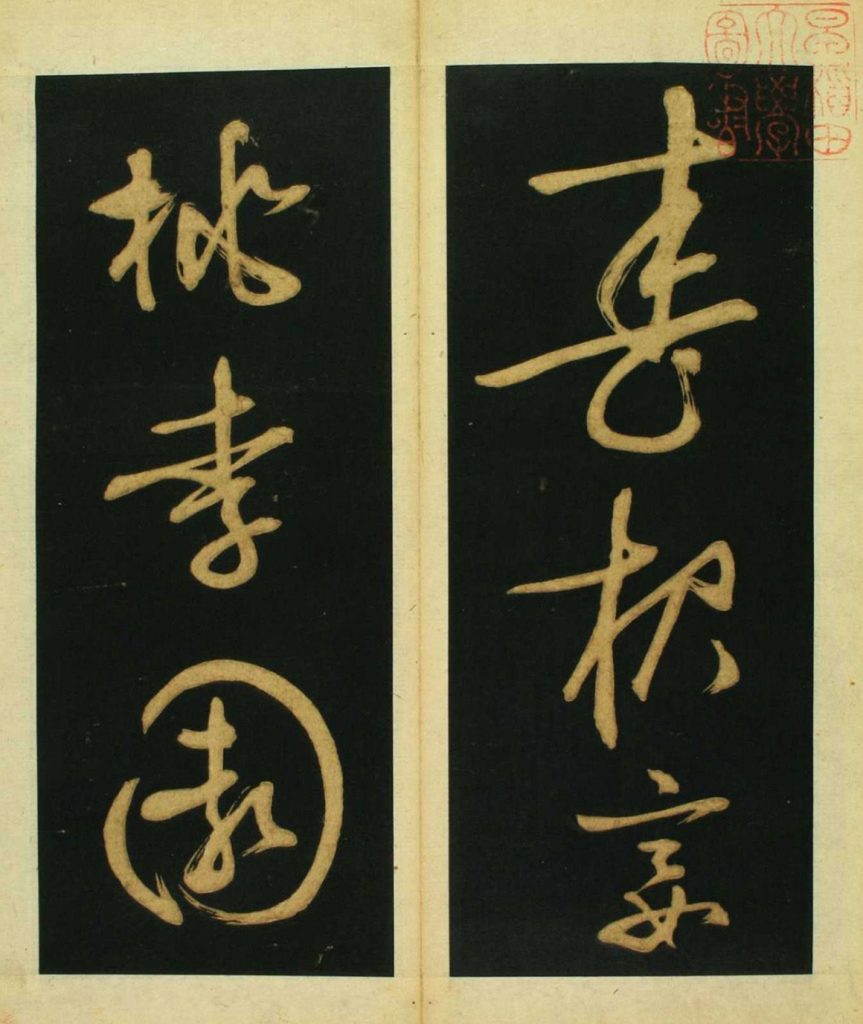
《春夜宴桃李園序》
李白
夫天地者,萬物之逆旅。光陰者,百代之過客。而浮生若夢,為歡幾何。古人秉燭夜遊,良有以也。況陽春召我以煙景,大塊假我以文章。會桃李之芳園,序天倫之樂事。
群季俊秀,皆為惠連;吾人詠歌,獨慚康樂。幽賞未已,高談轉清。開瓊筵以坐花,飛羽觴而醉月。
不有佳作,何伸雅懷。如詩不成,罰依金谷酒數。
***
The following seal, carved by Qi Baishi 齊白石, features a line from ‘Inscribed on the wall of the Temple of Gathered Herons’ 題鶴林寺壁 by Li She 李涉 of the Tang dynasty:
Amidst my days of drunken mindlessness,
in late spring I struggled up into the mountains.
Chatting there with a monk in his lush temple —
a stolen carefree moment in this my floating life.
終日昏昏醉夢間,忽聞春盡強登山。
因過竹院逢僧話,偷得浮生半日閒。

***
Qi Baishi’s carved seal brings us back to Wu Zuguang who, along with the Tang poet Li Bo, is a protagonist in Bring on the Wine!. In 1951, Wu was introduced by fellow playwright Lao She to Xin Fengxia 新鳳霞, a renowned young opera singer. Although Lao She would go on to betray his friend, Zuguang and Fengxia remained faithful to each other to the end of their days.
In 1954, when Zuguang’s enthusiasm for New China was at its height, he and Fengxia often entertained fellow prominent cultural figures at their stylish courtyard home in Dongdan. One of their guests was the acclaimed ninety-year-old artist Qi Baishi. Known for enjoying the company of attractive female acolytes, Qi pursued a friendship with Fengxia by teaching her how to paint (at least, this is the way that Fengxia described her artistic awakening to me herself). Apart from the voluminous memoirs that she wrote in her later years, Fengxia remained passionate about making art.
